Polyhedra Photography
(See also: Fractal Photography)
The contents of this page are © Copyright Gayla Chandler and may
not be used without her permission.
[Click on the images for an enlarged version]
|
|
|
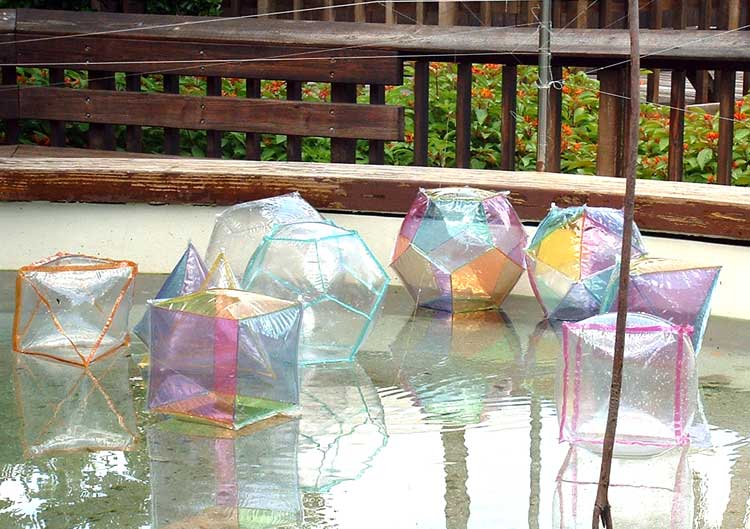
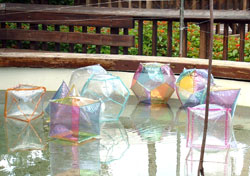
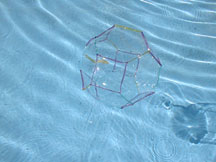
The first photo shows assorted collapsibles floating in a marine tank at the Gumbo Limbo Environmental Center at 1801 North
Ocean Blvd. in Boca Raton, Florida. In this particular tank there are several varieties of fish, a sea star, a few stingrays, and
a poisonous spiny looking creature that I didn't get a picture of (but plan to this summer 2003). The tank has a huge circumference, is fairly shallow,
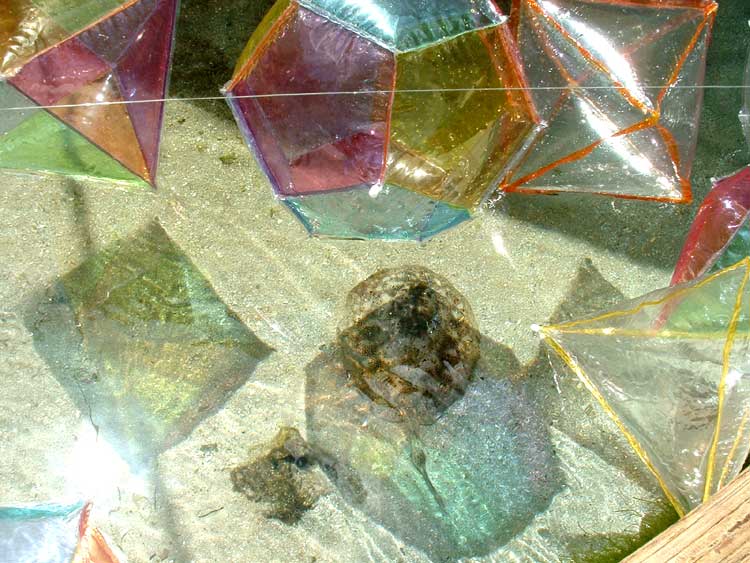
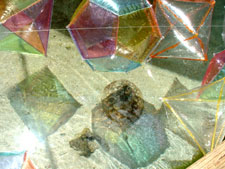
with sand covering the bottom, probably because stingrays like sand. The middle photo shows a stingray with the collapsibles. The fish darted
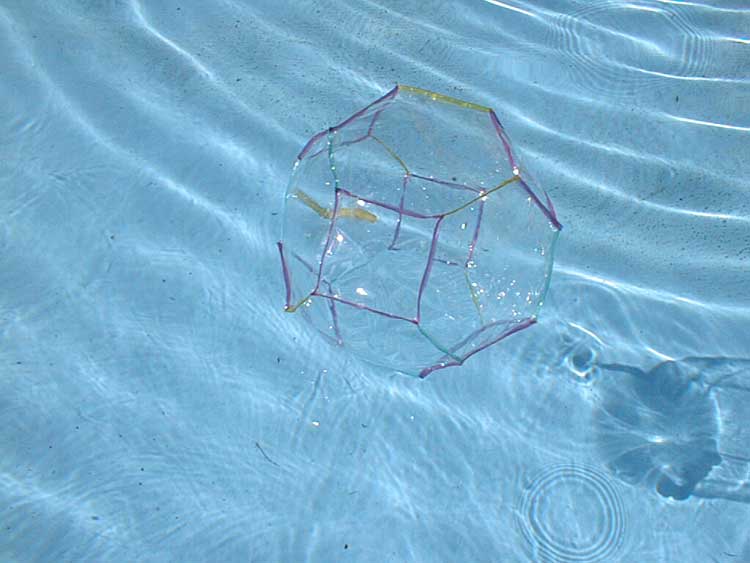
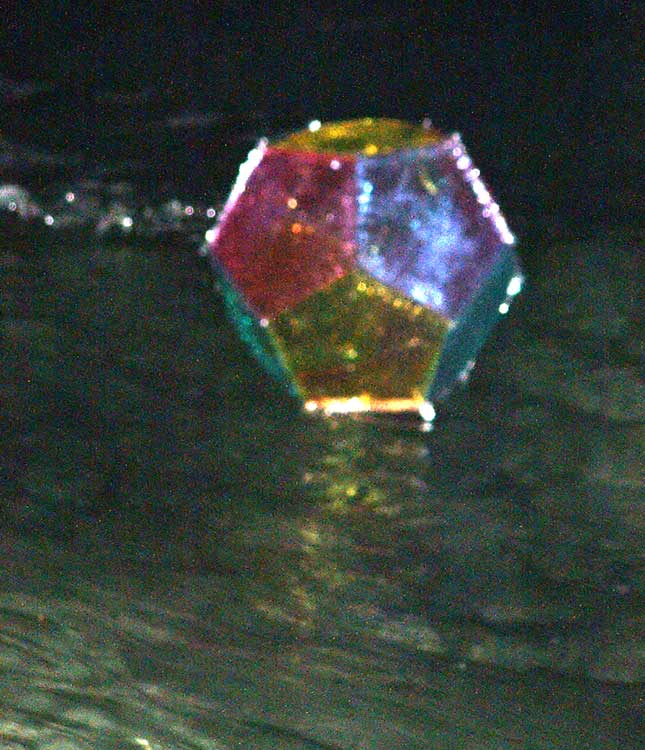
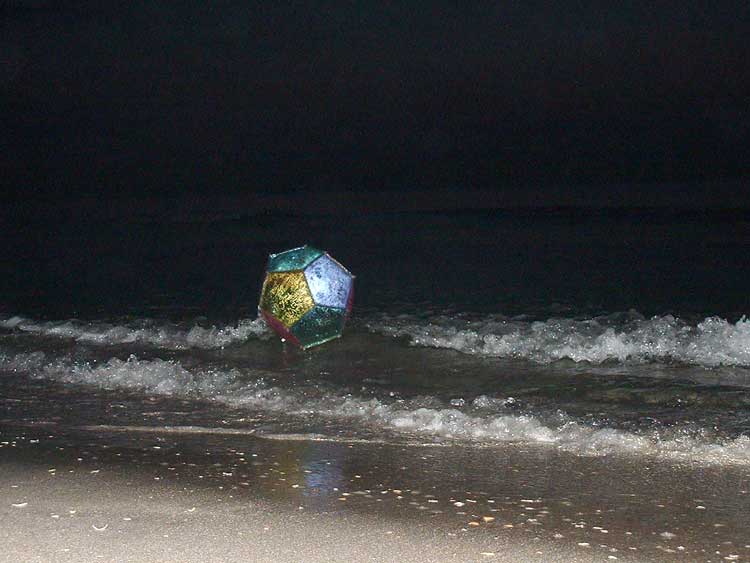
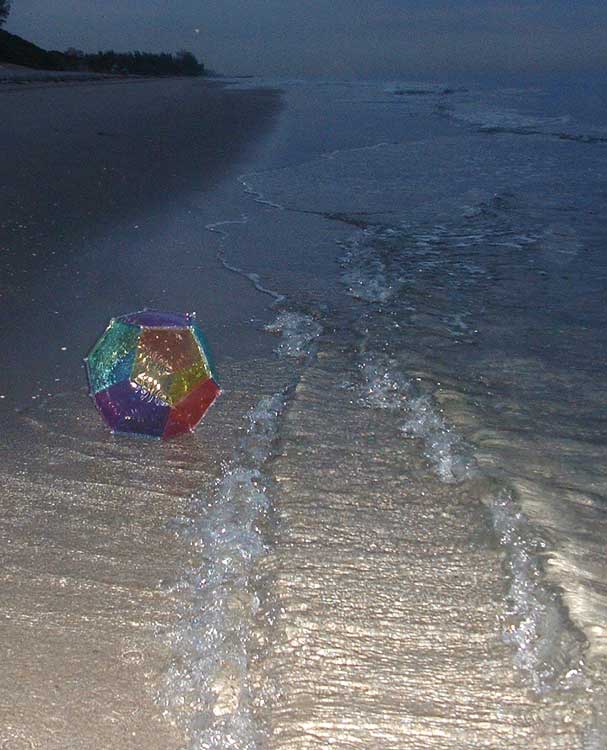
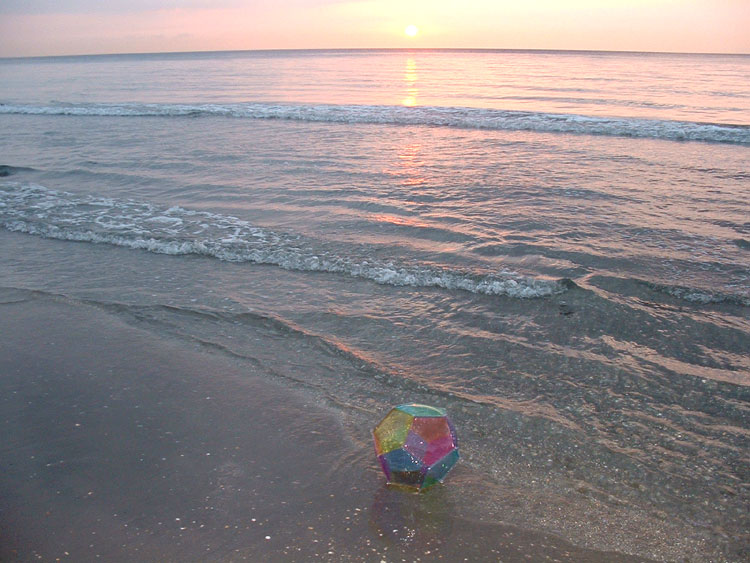
from the structures, while the stingrays stayed close. The photo on the right shows a permutahedron for n=4 floating in a fountain
at Arizona State University. Its 24 vertices are the 24 permutations of the set {1,2,3,4} or any other set of 4 distinct elements. It happens that
the permutahedron for n=4 is either one and the same structure as the snub octahedron, or is isomorphic to the snub octahedron, one of the
Archimedean solids. The permutahedron for n=3 is a hexagon, whose vertices are the 6 permutations of {1,2,3}. The permutahedron for n=2 is
a line with endpoints being the 2 permutations of {1,2}, and the permutahedron for n=1 is a single point. Shelly Smith, a graduate student with
the Department of Mathematics and Statistics at ASU, has done research on the permutahedron, and helped me with wording/notation to ensure
accuracy/clarity of the information presented here.
|
|
|
|
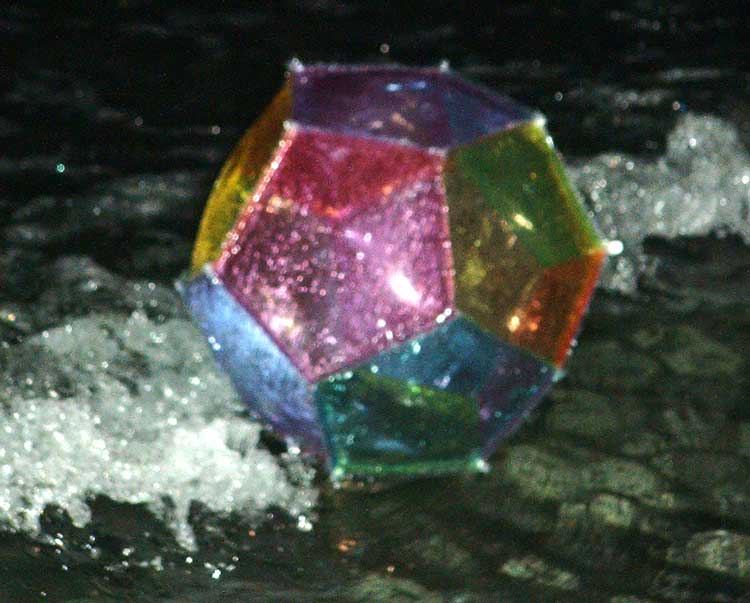
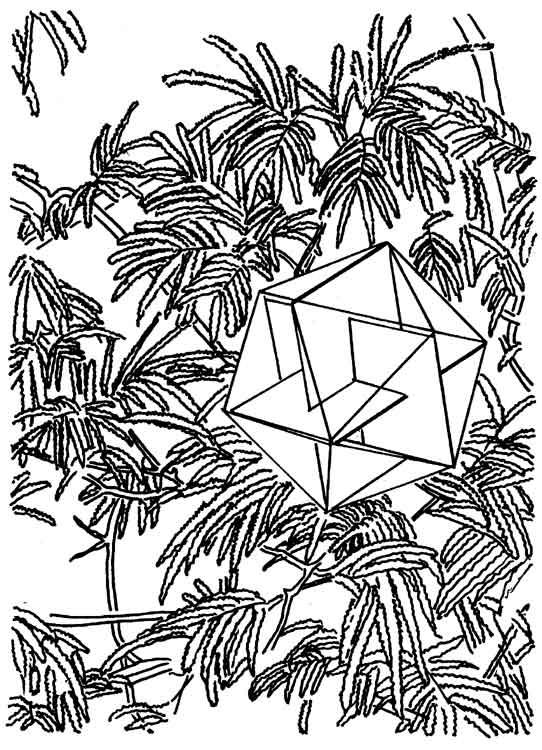
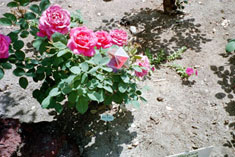
On the left is my favourite of all the icosahedron pictures, because it looks like the rose bush "grew" an
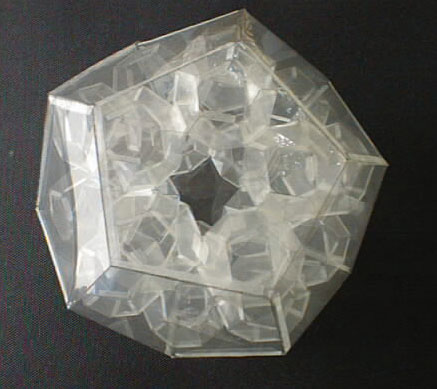
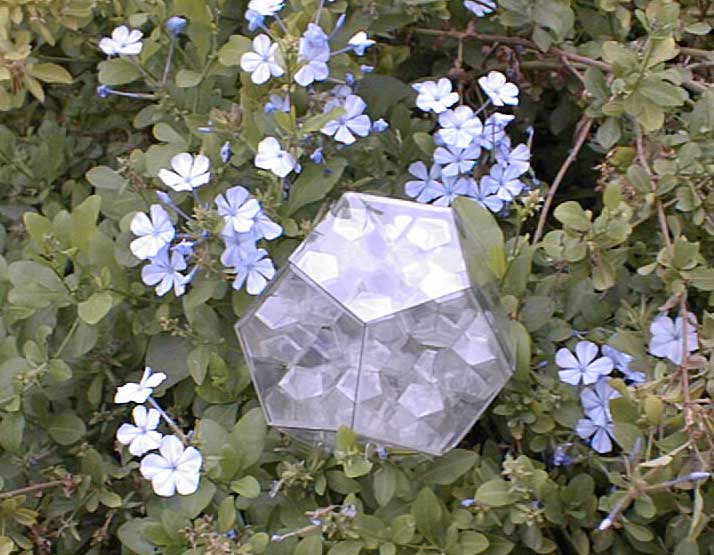
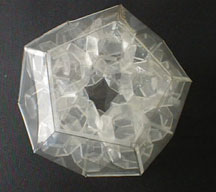
icosahedron, so well does it fit into the picture. To the right are two views of a stage-1 dodecahedron fractal that is sitting inside of a dodecahedron
(the stage-0), all made from transparency film. The stage-1 is made up of 20 dodecahedra connected together to form another dodecahedron with volume
removed. My construction of it is very crude, embarrassingly so, but it might be enough to get a sense of the structure. The advantage of using transparency film
was being able to see through it, yet this left the interior with very little definition. It is hard to see the stage-1 inside! A solution might be to leave the outer
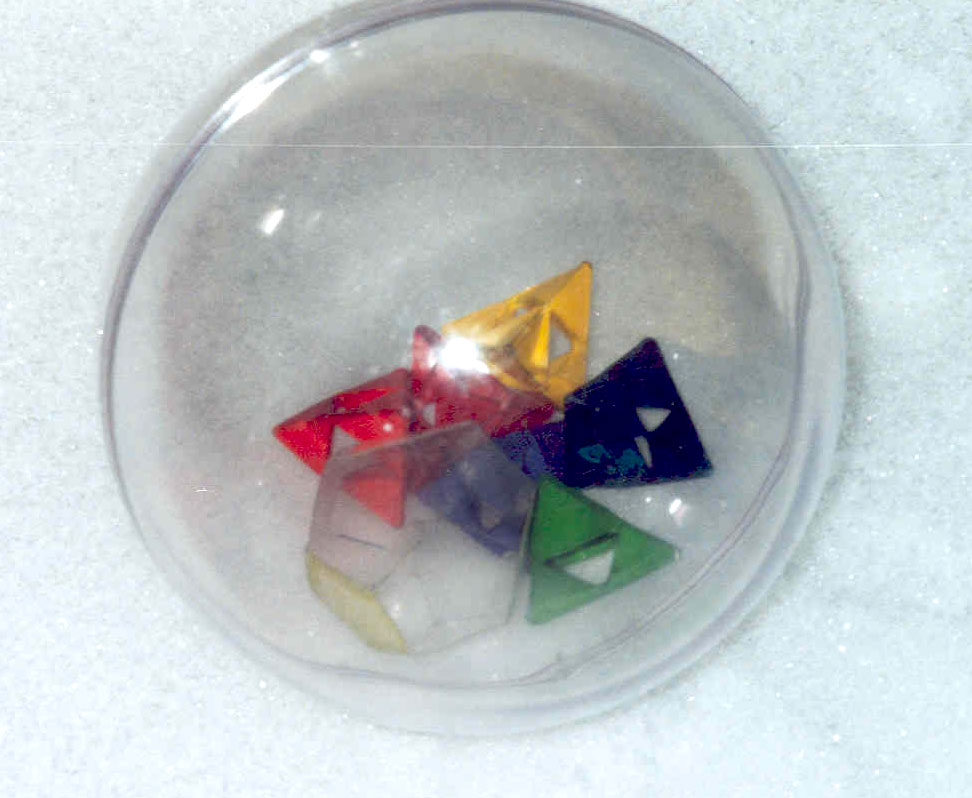
dodecahedron transparent, but add colour to
the 20 miniature dodecahedra patterns (leaving the tabs clear so not to double up on the color) and print them out on transparency film.
This would let the stage-1 structure stand out vividly inside the outer clear dodecahedron, and would maintain at least a semi-transparent quality to the overall
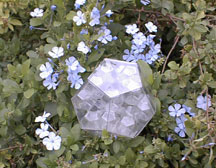
structure. In the image on the
far right, the little purple flowers have 5-fold symmetry (n-fold symmetry where n=5), set off nicely against the 5-fold symmetry of the dodecahedron.
|
The contents of this page are © Copyright Gayla Chandler and may
not be used without her permission.
|